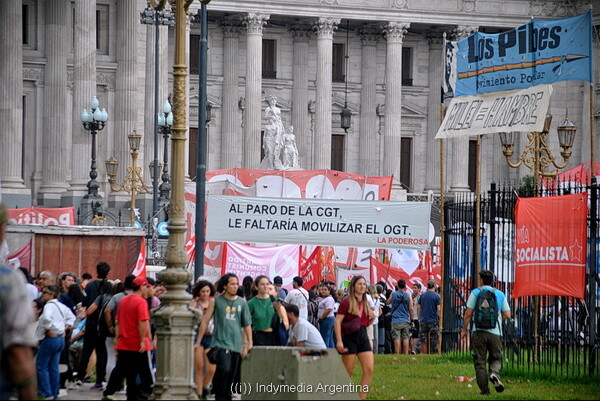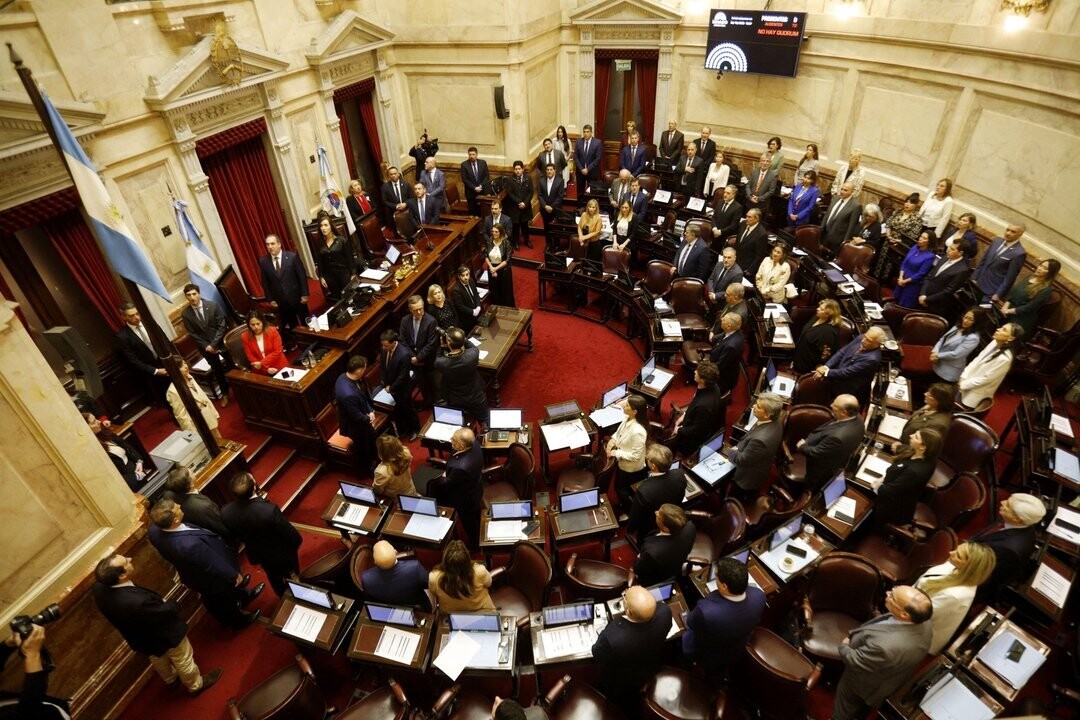
Buenos Aires, February 25 (NA) – With the wind at its back, the ruling coalition will return tomorrow to the Senate chamber with the aim of approving the reform to the Glacier Law and the ratification of the trade agreement between Mercosur and the European Union. In the session, which will begin at 11, it is also planned to consider the nomination of former national deputy Fernando Iglesias as Argentine ambassador to Belgium and the European Union, as reported by the Argentine News Agency. On Friday at the same time, another session has been called in the upper house to deal with labor reform and juvenile criminal regime projects, both coming from Deputies. Mercosur-EU Agreement The bi-regional agreement between Mercosur and the European Union was to be dealt with in the Friday session of the upper house, along with the juvenile criminal regime and the labor reform project, but the Government ordered to move up the timeline. The decision of the Casa Rosada is due to the fact that the Parliament of Uruguay accelerated the process of ratification of the trade agreement and could approve it in the next few hours. The Government of Javier Milei wants to be the first to give the green light to the treaty because it intuits that if it becomes the first trading partner it could access differential advantages and benefits with respect to other countries in the region that compete for the same goods markets. The votes to approve it are secured and it is estimated that the peronist bloc led by José Mayans will vote divided as it happened the week before in the Chamber of Deputies. The trade agreement between Mercosur and the European Union that was approved yesterday in the Chamber of Deputies was signed on January 17 in Asunción, within the framework of a ceremony that had the participation of President Javier Milei and his peers from Paraguay, Santiago Peña, and from Uruguay, Yamandú Orsi, to which the Brazilian president, Lula da Silva, was absent. The trade treaty, one of the largest bi-regional agreements on the planet, cannot yet be implemented because the European Parliament decided by a majority vote of its members to refer it to the Court of Justice of Europe for analysis of its impact and to decide on its entry into force. According to its promoters, the implementation of the trade agreement between the two regional economic blocs would allow to reduce tariffs on more than 90% of Argentine exports, and to cut access barriers for European industrial goods. Among other implications, tariffs on chemicals, pharmaceuticals, machinery, clothing and beverages are eliminated. The agreement implies the creation of a free trade zone with a market of more than 700 million consumers, which represents 20% of world GDP. The European Union is the second largest trading partner of Mercosur after China and ahead of the United States. In addition, the European Union is one of the main sources of Foreign Direct Investment, and it is the second largest global importer of goods. Glacier Law Reform The ruling coalition is confident to hold the debate in the chamber on the reform to Law 26.639 of Minimum Budgets for the Protection of Glaciers and the Periglacial Environment, but at the last moment the radicalism put on the table an alternative project from the UCR senators that does not give so much power to the provinces in the determination of the protected zones. According to Argentine News Agency from parliamentary sources, negotiations are intense and seek to find a solution so as not to frustrate the approval of the initiative (whichever version) in this Thursday's session. The approval of this project is a commitment assumed by the Government with the governors of mountainous provinces that seek a more dynamic and less rigid law than the current one to unblock and multiply investments in mining and hydrocarbons. In Peronism, which would mostly lean towards rejection, there could be leaks since it is uncertain the position that former governors of mining provinces such as Lucía Corpacci (Catamarca) and Sergio Uñac (San Juan) could take, to give some examples. Both the project of the Executive Power and the alternative of the UCR will seek to define the scope of the protected areas to allow economic exploitation in certain periglacial areas that are currently shielded and disabled for extractive and industrial activities. Precisely, the Government's project introduces a clarification when speaking of "periglacial forms", and encourages distinguishing between those that fulfill functions of "strategic reserves of water resources and suppliers of water for the recharge of river basins" from those that do not necessarily fulfill said purpose and are suitable for economic use. This means that with the new law not all the periglacial territory would be safe from economic exploitation, but only those formations that have a demonstrable water function. The current regulation, dating from 2010, protects both visible glaciers and periglacial formations that are made up of a mixture of frozen freshwater soil, rock and sediments. They are very cold high mountain ecosystems, freshwater reservoirs usually close to glaciers, which are characterized by having frozen or water-saturated soils and play an important role in the regulation of the hydrological and geomorphological balance. With the proposed modification, the prohibition for the development of economic activities in glaciers is maintained, but a door is opened to carry out investment projects in areas that do not have a demonstrable water function. The project creates the National Inventory of Glaciers, whose compilation and operation will be in charge of the Argentine Institute of Nivology, Glaciology and Environmental Sciences (IANIGLA), with the coordination of the Secretariat of Energy, which is the authority in charge. Through the inventory, the technical body will have the function of individualizing glaciers and periglacial forms in the national territory, and on the latter it must differentiate between those that comply with the water function from those that do not. Among the prohibited activities, that is, those that "significantly alter the natural condition" or the water value of the glaciers, are those that release polluting substances, waste or chemical products; architectural or infrastructure works; mining or hydrocarbon exploration and exploitation; and industrial activities. In turn, the permitted activities are scientific research, emergency rescue tasks, and the practice of non-motorized sports such as mountaineering and climbing. The main difference between the Government's project and that of the UCR is that the former transfers to the provinces the faculty to determine which areas to protect (as strategic reserves of water resources, biodiversity or scientific value) and which not, and they are empowered to propose modifications to the National Inventory of Glaciers (prior environmental assessment report); while the UCR initiative gives full power to IANIGLA. The Government's position in favor of giving control and regulation faculties to the provinces on minerals and hydrocarbons is based on article 124 of the National Constitution incorporated in the 1994 reform that recognizes the original domain to the jurisdictions of natural resources under the soil. If the initiative is strongly defended by the mining and hydrocarbon provinces of the mountain range, with the same intensity it arouses fierce rejections from environmental assemblies and also from the Church, which made known its discontent with the advance of the project through a letter from the Argentine Episcopal Commission. The sectors that close ranks against the project warn that the protection of glaciers and periglacial zones, strategic pillars for the provision of fresh water for human consumption, sustainable agriculture and biodiversity, should not be negotiated in the face of short-term sectoral corporate interests. These organizations mobilized throughout the country denounce that the reform to the Glacier Law is an "unconstitutional environmental regression" because it violates the Escazú Agreement to which Argentina adhered; and they defend the current standard because it establishes a floor of protection for these particular ecosystems.